
Small Incisions, Big Advances: Transforming OB/GYN Care in Teton County
- Category: Women's Health, Robotic Surgery
- Posted On:
- Written By: St. John's Health
As part of an ongoing commitment to expand access to women’s healthcare in our region, St. John’s Health is proud to offer advanced OB/GYN services and treatments—including the Bulkamid procedure for stress urinary incontinence, and robotic-assisted surgeries for a range of gynecologic conditions.
__
Offering these cutting-edge services ensures patients in our community can access critical OB/GYN care and the latest expertise, closer to home. In a region that has struggled with gaps in women's health care, it’s a big step towards filling an essential need.
To tell us more about what minimally invasive procedures and robot-assisted gynecologic surgery means for our patients, we spoke with Dr. Timothy Bussert, OB/GYN and surgeon at St. John’s Health.
What first drew you to medicine, and to a focus on OB/GYN?
Dr. Bussert says he was first called to medicine “because of the juxtaposition of science with humanity.” He describes the decision to focus on OB/GYN as “a bit of a surprise,” but says he “loves the opportunity to be able to help women through some of the most exciting and terrifying times of their life.”
“The OB/GYN field is exciting and unique, combining my favorite elements of primary care and surgery. I can develop and maintain long-term relationships with patients, deliver babies, perform in-office procedures and major surgeries—sometimes all in the same-day!”
What is your background with minimally invasive, robotic-assisted surgery?
“My surgical experience is primarily laparoscopic and robotic for management of conditions such as abnormal uterine bleeding (heavy , frequent, and/or painful periods), fibroids, endometriosis, chronic pelvic pain,” says Dr. Bussert.
“In my previous position, I performed high volumes of a variety of surgeries including endometriosis excision, myomectomy and hysterectomy, which allowed me to polish my technique. When it comes to surgery, repetitions matter—the more a surgeon does, the more operating times and complication rates are reduced and outcomes are optimized.”
How does robotic-assisted OB/GYN surgery work?
During a robotic-assisted procedure, Dr. Bussert operates tiny surgical instruments from a console that sits beside the patient. A high-definition, 3D camera provides a magnified view inside the body, supercharging his vision with the utmost clarity. When Dr. Bussert moves his hands at the console, his exact motions are translated in real time to the surgical instruments. This allows him to make ultra-precise, controlled movements during the procedure, and ultimately enables a less invasive and more efficient surgery.
What is the advantage of robotic-assisted surgery for OB/GYN patients?
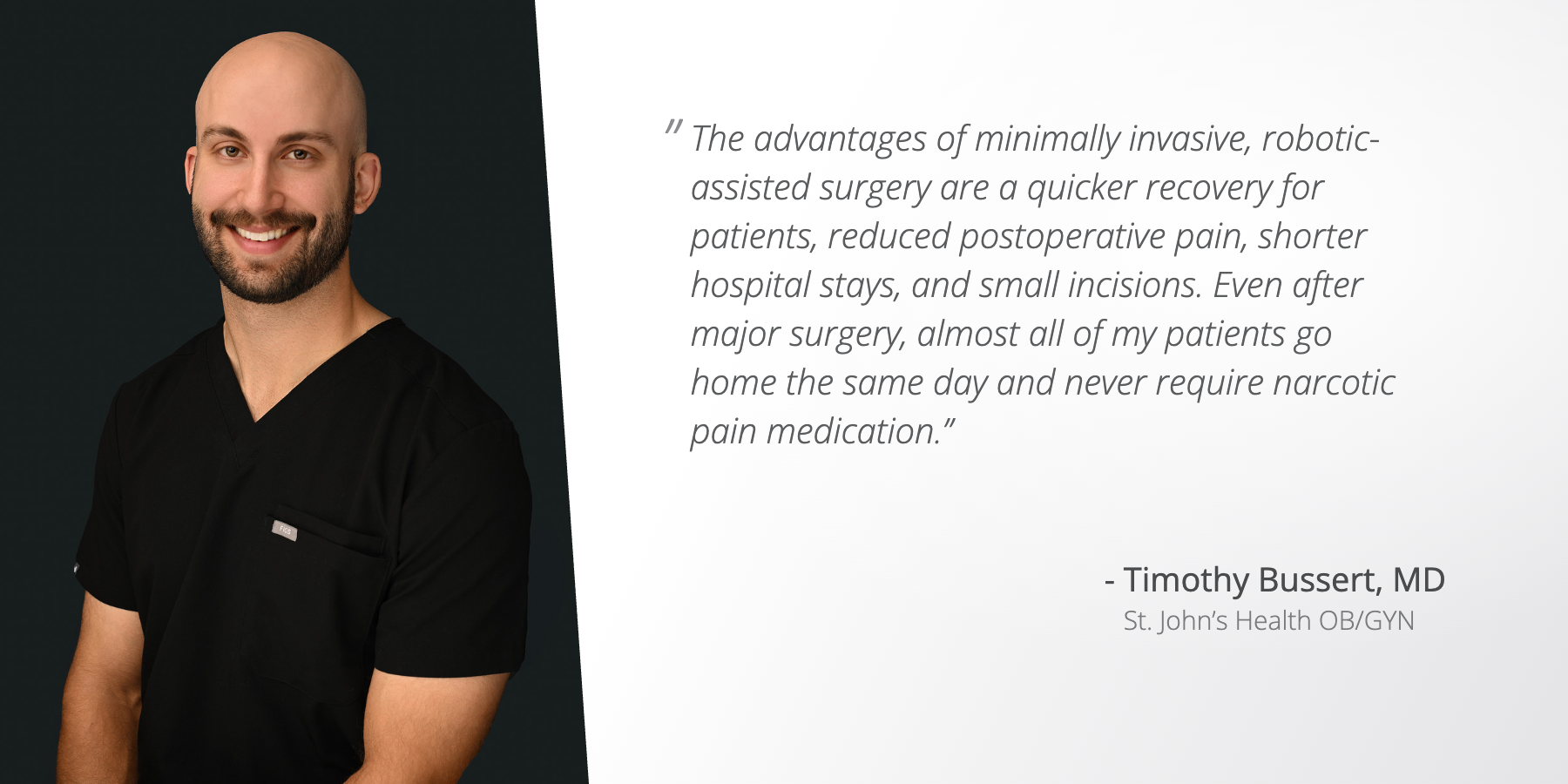
“The principal advantages of the minimally invasive, robotic-assisted surgery is a quicker recovery for patients, reduced postoperative pain, shorter hospital stays, and small incisions,” explains Dr. Bussert. “Even after major surgery, such as a hysterectomy, almost all of my patients go home the same day and never require narcotic pain medication.”
What is the Bulkamid procedure and who is it for?
The Bulkamid procedure is a quick, minimally invasive treatment designed for individuals experiencing female stress urinary incontinence (SUI).
“The procedure is done via a cysto-urethroscope, which is a small camera passed through the urethra under sedation. This offers a highly effective, incision-free, mesh-free alternative for treating bothersome SUI,” says Dr. Bussert.
“SUI is a very common condition in women that presents as leaking urine with exercise, coughing, sneezing, and laughing,” says Dr. Bussert. “It’s estimated to affect about one third of all women but is more common in those who have had children.”
____
Dr. Bussert is currently accepting new patients at St. John's Health OB/GYN. To schedule an appointment, please call (307) 739-4880.