For Local Cancer Patients, the Road to Healing Is About to Get Shorter
- Category: Cancer Care, St. John's Health Foundation
- Posted On:
- Written By: St. John's Health
When Jim Eden was diagnosed with prostate cancer, he faced a journey that no Teton County resident should have to navigate alone. Jim, a longtime SJH Foundation board member, a man who gave years of his life to supporting local healthcare, needed radiation treatment. And it wasn't available here.
Like more than half of cancer patients, Jim's treatment required numerous radiation therapy appointments -- in his case, three per week for eight weeks, nearly two hours away in Idaho Falls. Since his son Mike was working full-time and unable to regularly drive back and forth, Jim lived in Idaho with a trusted caregiver throughout his treatment, support the family knows not all cancer patients have. Still, it was very difficult for an aging senior with other existing health issues including early dementia.
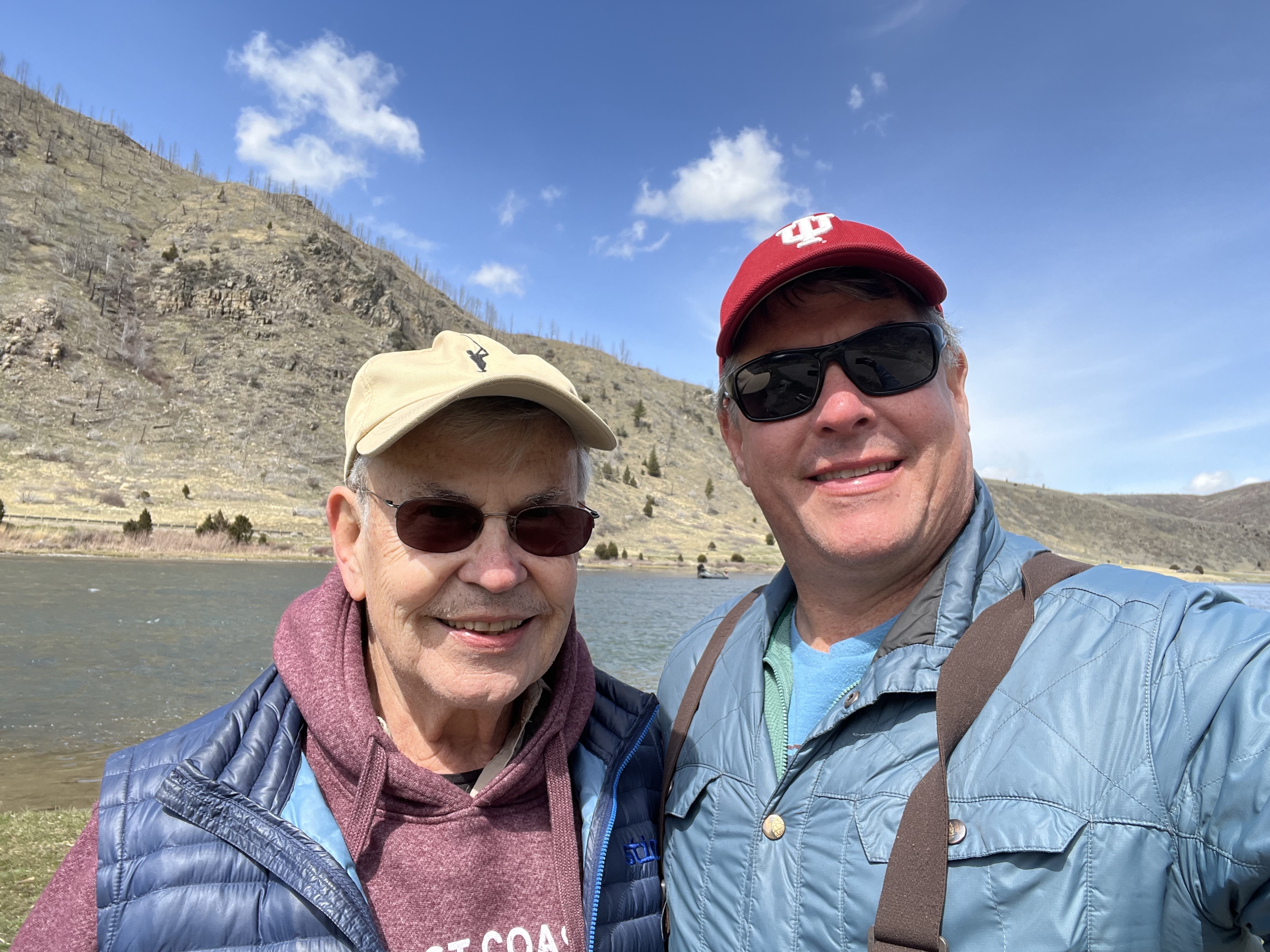
Jim’s story is not unique. In 2025, St. John's Health Oncology cared for more than 1,100 individual patients. Thanks to a decision of the St. John’s Health Foundation board of directors, the road to healing for local cancer patients just got shorter. Every dollar raised by the Foundation toward its campaign goal means we're a step closer to the day local cancer patients won't need to travel for this lifesaving care. (Pictured: Mike and Jim Eden)
The Right Decision at the Right Time
The decision to advance plans to build a new Cancer Center -- with a linear accelerator for radiation therapy -- didn't come quickly or quietly. It emerged from SJH's strategic planning process, shaped by input from community members, medical providers, staff, and industry finance experts. The consensus was clear: the lack of local radiation treatment isn't merely an inconvenience. For seniors, working parents, and many others, it's a barrier that can lead to delayed care, incomplete treatment, and profound hardship.
As long-time internal medicine physician Mike Menolascino, MD reflected, this moment has been decades in the making:
"From the early efforts of Judy Basye, RN, and Dr. John Ward, the visiting oncologist from Huntsman Cancer Institute, our local cancer program was built on a shared belief that patients in Jackson deserve access to high-quality cancer care close to home, despite our rural setting."
In 2023, St. John's Health recruited Melissa Cohen, MD, the area's first full-time board-certified medical oncologist, a milestone that immediately drove a 22% increase in the number of patients served. The oncology team also includes Daniel Miller, MD, who oversees brachytherapy radiation, and oncology surgeon Hannah Caulfield, MD, among other surgeons and specialists. Patients leaving for radiation therapy aren't leaving by preference; they leave because there has been no alternative. With the expertise now in place, and community need growing, the time to add the final core oncology service, radiation therapy utilizing the linear accelerator, has arrived.
Planning for Today's Healthcare Finance Challenges
The Board of Trustees and Administration are acutely aware of the financial challenges facing U.S. hospitals, particularly those in rural areas. Rigorous expense management plans are in place, and SJH is fully committed to remaining independent in order to keep vital services available locally.
The financial projections for the new Cancer Center are intentionally conservative, based only on the new radiation program. The Board of Trustees made it clear that risking the financial position of the institution wasn't an option, and feasibility of the project depends on the Foundation meeting its fundraising goal. With the support of the Foundation for capital, the program will contribute to the hospital's financial bottom line beginning in year one, with an estimated $1.2 million contribution by year five.
The projection for year one is 80 individual patients, each receiving multiple treatments, which reflects a conservative 41% market capture rate, well above the break-even threshold of 51 patients. Directors from cancer centers in other Wyoming communities have indicated that patient volumes are likely to be higher, based on their experience. SJH projections are based on its actual insurance contracts, payer mix, and population, not national averages. Notably, the area’s population for age 65 and older is expected to grow 17% over the next four years, the age demographic in which cancer is most prevalent.
There is also a broader financial picture worth noting: when patients leave Jackson for radiation, they often receive their chemotherapy, imaging, surgery, and follow-up care in those same outside systems. A local program keeps patients and healthcare dollars in Teton County, strengthening the community hospital across the full continuum of care.
The plan has been rigorously scrutinized by the Trustees. Longtime community physician Brent Blue, MD was one of the Trustees who asked hard questions about cost, revenue, and long-term viability. He questioned whether evolving treatment technologies might make a linear accelerator obsolete, a concern he addressed directly with oncologists before reaching his conclusion:
"CFO Mitch Watson did a comprehensive analysis of what it would take to make a radiation oncology unit viable. The numbers were very conservative and positive. I question our finances at every meeting. Trustees do not take the finances of our rural hospital lightly. I believe a radiation oncology unit at SJH is worth the small risks for the large rewards."
The Commitment from the Foundation
Understanding SJH's need to maintain financial sustainability, the St. John's Health Foundation voted to raise $25 million, the full cost of the linear accelerator and facility renovation, through philanthropy. This eliminates debt service entirely and protects SJH’s cash position. The fixed operating costs referenced in public commentary are already reflected in the financial projections. The Foundation's contribution doesn't simply fund construction; it fundamentally improves the financial risk profile of the project.
What This Means for Patients Like Jim
SJH Oncologist Melissa Cohen, MD, sees firsthand what patients endure when they need to travel for essential cancer treatments:
"I have to explain that they will need to be away in Idaho Falls or Salt Lake City several days a week, for anywhere from three to six weeks. I watch patients do the math in real time: the drives, the lodging, the days of work missed, the family members who will need to rearrange their lives, the financial cost of all of it on top of everything else they are already carrying. I have watched the emotional toll that separation from home and community adds to an experience that is already the hardest thing a person can go through."
Mike Eden is now a member of the St. John's Health Foundation Board of Directors, carrying on a legacy his father built over many years. Had radiation been available five years ago, his dad would have received his care here. He would have slept in his own bed each night, with his family nearby. “I know nothing would please my dad more than patients being able to receive great care in Jackson instead of having to leave the valley,” he said.
What Happens Next
The St. John's Health Board of Trustees has advanced plans to build a new Cancer Center, with the Foundation's fundraising campaign underway. Public Board of Trustees meetings are open to the community. Those interested in supporting the Foundation campaign are invited to contact Foundation President Anna Olson at 307-690-7669.